
Why I built it
I wrote the library for my own LinkedIn posts. LinkedIn labels images made with AI, and I don’t see a difference between AI and any other tool I use to make a picture. So I took the label off.
Open-source library · by Victor Kuznetsov (@wiltodelta)
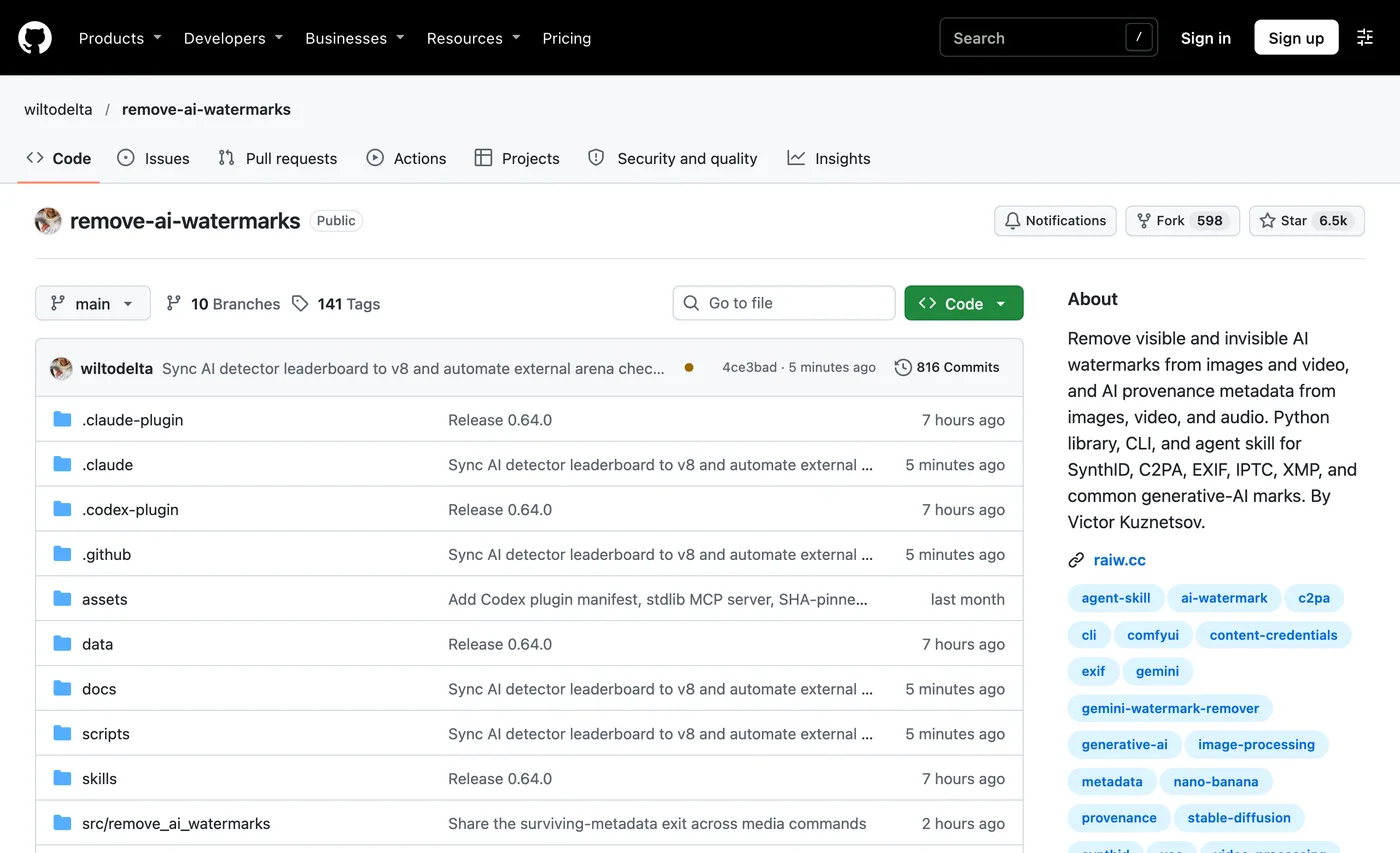
Inspect and remove supported AI provenance marks and metadata from images, video, audio and text you generated yourself, from Python, the terminal or your coding agent.
I wrote the library for my own LinkedIn posts. LinkedIn labels images made with AI, and I don’t see a difference between AI and any other tool I use to make a picture. So I took the label off.
I never posted it on Hacker News. Someone else did, and within weeks GIGAZINE and Ledge.ai, two Japanese tech sites, wrote about it too. The repo went from a few dozen stars to about two thousand in four days.
Written about on Hacker News, GIGAZINE, Ledge.ai
Clean visible badges and vendor marks from Google Gemini, OpenAI, Microsoft, Sora, Veo, Kling, Runway, Doubao, Jimeng and Qwen, strip C2PA, EXIF, XMP and IPTC metadata, and process compatible audio and text watermarks.
Inspect a file before changing it to see signed Content Credentials, metadata tags and known visible marks, with clear notes on what local checks can and cannot prove.
Install it as a Python package, run it from the terminal over single files or folders, or add it as a skill so Claude Code, Codex or Cursor can inspect and clean assets in a workflow.
Gives creators and developers control over provenance marks on content they generated themselves, and never targets stock-agency, marketplace or copyright watermarks.